
Suzanne Botta Sullivan reports on the past year’s activities
I am pleased to report that 2012 was another outstanding year for Menunkatuck Audubon Society. With your financial support and the hard work of the Chapter Board members and many volunteers we have conducted a vast array of programs, field walks, and conservation studies, worked on habitat restoration, increased our schoolyard habitat programs, and much more. With great pride, we list here for your review the significant accomplishments achieved in 2012.
“What struck me is that it is the individual people and the group as a whole that make what you are doing so extra special. The depth and enthusiasm of your Menunkatuck Audubon board is truly amazing. Your board has diversity of age and experience, strong ties to the community, and the expertise of professional educators.“
-Diane Lewis, Special Consultant to David Yarnold, President, National Audubon Society
Conservation
The Hammonasset Beach State Park Purple Martin and Tree Swallow Project, begun in 2005, continues to produce outstanding results. Nesting attempts by European starlings and house sparrows have been reduced and astonishingly high success rates for both the purple martin colonies and the tree swallows has followed (180 purple martin fledged and 151 tree swallows fledged).
A fifth osprey platform was installed in the Park. Nesting ospreys used all of the new platforms.
Two kestrel nest boxes were installed at the Guilford Salt Meadows Sanctuary with additional boxes planned for other sites in Guilford.
 |
| Terry Shaw completes the installation of a kestrel nest box at the Guilford Salt Meadows Sanctuary. |
In partnership with the Madison Conservation Commission Menunkatuck continued the Dune Restoration Project at West Wharf in Madison. Additional beach grass plugs were planted.
 |
| Dune grass plugs are planted at the West Wharf dune in Madison. |
Additional fishing line recycling bins were installed at boat launches and fishing spots.
Citizen Science
Menunkatuck concluded its partnership with the Connecticut Amphibian Monitoring Project (C.A.M.P.) monitoring a 2.5 square mile area for amphibians. The statewide study sponsored by the Connecticut DEEP and Connecticut Science Center ended its 15-year data collection.
Our partnership with the Project Limulus horseshoe crab tagging surveys had more than 60 volunteers conduct 21 surveys.
Menunkatuck members participated in Audubon Connecticut’s spring and fall bird migration surveys to identify critical stopover habitat.
A partnership with the Seabird Ecological Assessment Network was initiated. SEANET recruits volunteers to survey beaches for sick and dead seabirds.


Advocacy
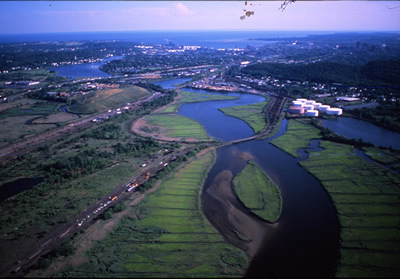
Menunkatuck partnered with Audubon Connecticut, Quinnipiac Valley Audubon Society, and other conservation organizations in Improving Water Quality and Wildlife Habitat in the Quinnipiac River Watershed. A series of films were shown at the Yale Peabody Museum and at venues in the Wallingford area. A public forum with area legislators was also held. The project is supported by a grant to Audubon Connecticut from the Quinnipiac River Fund.
Another new partnership is with Balloons Blow, an organization that publicizes the harmful effects of balloons on wildlife and the environment.
 |
 |
| A rusty blackbird got entangled in balloon string. |
Education and Outreach
The Birdathon was held in May. The day was a great success. Menunkatuck and The Audubon Shop participated together and a total of more than 100 species were counted.
Menunkatuck continued to support King-Robinson Magnet School in New Haven. In June we sponsored two programs by A Place Called Hope live birds of prey program.
The Audubon at Home Schoolyard Habitat Program included construction of a large courtyard planter for a hummingbird/butterfly garden at King-Robinson. Audubon Connecticut was awarded a grant by the Carolyn Foundation to partner with Menunkatuck on expanding the program by establishing a wildlife meadow, equipment purchases, and teacher training.
 |
| The planter at King-Robinson is constructed with Timbersil, a non-toxic treated wood, and cedar. |
 |
| Melissa Jone Elementary School students pose with the Audubon at Home Healthy Habitat sign. |
Abraham Baldwin Middle School in Guilford had an AAH habitat assessment in May and during the summer implemented many of its recommendations. Sue Kennedy obtained grants from the Guilford Fund for Education and the Guilford Foundation. With the assistance of students from the Guilford High School Environmental Club a courtyard was converted from an area overgrown with day lilies to a garden with diverse bird and butterfly attracting plants. Art and science teachers used the garden during the fall for curriculum-related studies.
 |
| A Baldwin student sketches in the new school garden. |
Film Series
Film screenings continued in partnership with Audubon Connecticut and the Blackstone Library. Eight independent documentaries on environmental issues were shown to excellent reviews.
 |
| Among the films shown was Mad City Chickens. |
General Public Meeting
Public programs are held monthly on the second Wednesday of each month (except July and August). Last year the meetings featured a variety of topics and speakers, including programs on birding in Colombia, ticks, a trip to the Galapagos Islands, and the Connecticut River watershed. Our meetings are free and open to the public.
Field Programs
This year Menunkatuck provided four exciting field programs, including a woodcock search at Durham Meadows, a spring trip to the Livingston Ripley Waterfowl Conservancy in Litchfield, and a fall walk at Hammonasset.
Newsletter
The newsletter is printed six times per year. In addition to informing our members and friends about Menunkatuck’s activities and events we include Cindi Kobak’s “Bio-bits” natural history essays. The Newsletter also includes tips on going green and information about upcoming events in our chapter area. Citizen Science highlighted six opportunities for helping scientists with their research.
Web Site
Menunkatuck maintains a web site that features a blog, a photo gallery, and a variety of educational information and links. We are also on Facebook with frequent posts with photos, event notices, and links to bird and environmental articles on the Internet.
Volunteers
Menunkatuck volunteers contributed more than 700 man-hours to conservation, advocacy, education, and outreach activities.
Conclusion
Menunkatuck continues to be a leader in environmental education, conservation, and advocacy. Please join the Menunkatuck Board in making 2013 an even better year. If you can become more involved please e-mail me at president@menunkatuck.org or speak to any Board member at any event.
~Suzanne Botta Sullivan


