Friday, August 26, 2011

Green Sea Turtle Found Trapped in Fishing Line

New London Day:
Originally mistaken for a lobster buoy, the endangered sea turtle was found with its neck and extremities bound in fishing line, covered in algae, and with a severely inflamed front and rear flipper (possibly from crab and other sea life nibbling), showing signs the turtle was trapped for a significant amount of time. 


Retrieve your fishing line. There are fishing line recycling bins located at popular fishing spots.

(New London Day photos.)

Friday, July 29, 2011

Osprey with Hook and Monofilament Line

Barb Walker of Clearwater (FL) Audubon Society posted this on the Osprey Migration Group page.

Rescuers were called to St. Petersburg Beach regarding this osprey with a hook and monofilament line entanglement. He is able to fish and eat but if he weakens and comes down to the ground we will know it and will grab him. He is being monitored by area residents, nearby workers and volunteers.

The photos were taken by volunteer Wendy Meehan (used with permission).


Fishing line and birds do not mix.

Tuesday, June 28, 2011

Topsmead Bird Walk


It was a good day for bobolinks at Topsmenad on Sunday. We had 30+ in the three fields we hit.


Trip list:

Canada Goose
Turkey Vulture
Cooper’s Hawk
Red-tailed Hawk
Ruby-throated Hummingbird
Yellow-bellied Sapsucker
Downy Woodpecker
Eastern Phoebe
American Crow
Tree Swallow
Barn Swallow
White-breasted Nuthatch
House Wren
Eastern Bluebird
Veery
American Robin
Gray Catbird
Northern Mockingbird
Brown Thrasher
Yellow Warbler
Prairie Warbler
American Redstart
Ovenbird
Louisiana Waterthrush
Common Yellowthroat
Eastern Towhee
Chipping Sparrow
Song Sparrow
Northern Cardinal
Indigo Bunting
Bobolink
Red-winged Blackbird
Common Grackle
Baltimore Oriole
House Finch
American Goldfinch


Monday, June 20, 2011

Japanese Barberry and Lyme Disease

An article in the New London Day describes a link between the invasive Japanese barberry and Lyme disease.

Jeffrey Ward, chief scientist at the Connecticut Agricultural Experiment Station's Department of Forestry and Agriculture, and experiment station scientist Scott Williams have been doing research on the relationship between Japanese barberry, ticks that carry Lyme disease and deer overpopulation.

A highly invasive plant that forms dense canopies in forests - particularly those with high deer populations that eat most every other plant - Japanese barberry also creates moist, cool shelters that harbor ticks that carry the Lyme disease bacteria, Ward's and Williams' research has shown. Hot, dry conditions suppress tick populations.

At 28 study areas, including a parcel along Lord's Cove in Old Lyme, the two have been studying various aspects of the triangular relationship between ticks, deer and barberry, and spreading their message to land conservation organizations about the best methods for ridding forests of barberry. Deer serve as hosts for adult ticks, while the barberry functions as a nursery for ticks in their juvenile stages.

Williams said tick abundance in barberry-infested areas is 67 percent higher than those where native plants are predominant. Also, the percentage of ticks that carry the Lyme bacteria is higher - 126 infected ticks per acre versus 10 per acre in barberry-free areas, Williams said, though the reason for that is as yet unclear. After barberry removal, Ward said, tick populations drop as much as 80 percent.

Go here for the full story.


Monday, June 13, 2011

Judy Knowles Talks about Horseshoe Crabs on WPKN

Menunkatuck's Project Limulus coordinator Judy Knowles was interviewed about the horseshoe crab research study on WPKN this afternoon. The interview is archived at http://archives.wpkn.org/bookmarks/listen/20959 and begins at about 15 minutes.

Monday, June 6, 2011

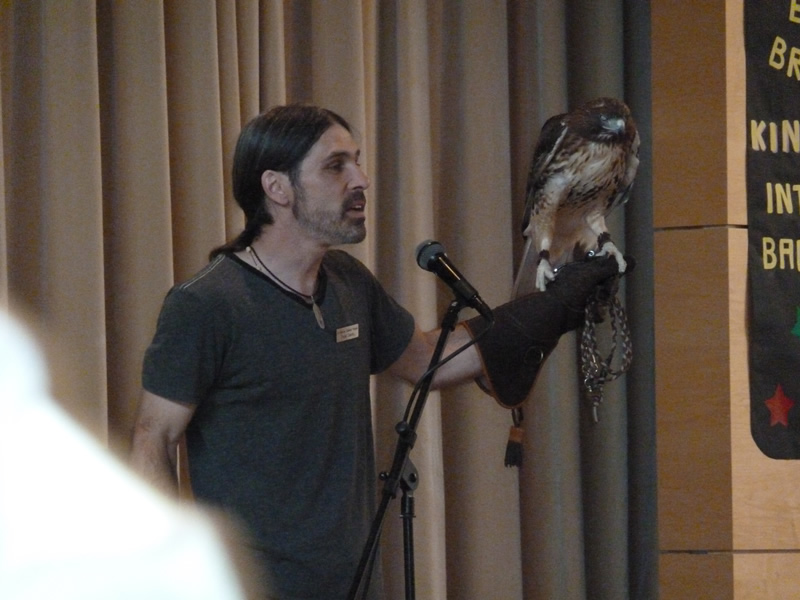
King/Robinson Students Experience Raptors from A Place Called Hope


The students at King/Robinson Magnet School in New Haven experienced live raptors from A Place Called Hope Raptor Rehabilitators today. In two programs, one for the Pre-K to Grade 4 students and the other for the Grade 5 to Grade 8 students, Christine Cummings and Todd Secki brought out five birds of prey.
An eastern screech owl and a great horned owl were the birds used to describe the unique features of owls. A red-tailed hawk and a broad-winged hawk showed the similarities and differences between the largest and one of the smallest hawks found in Connecticut.
The upper level students also got to see a barn owl in its second performance since coming to A Place Called Hope. The barn owl showed little of the shyness that Christine and Todd thought it might and gave the students a good show.


Monday, May 30, 2011

Menunkatuck Joins in Fishing Line Recycling Program


Menunkatuck has installed these cool fishing line recycling bins at several locations within our chapter area. Please deposit all fishing line you use (or find) into these bins to protect birds and other wildlife from entanglement. The bins will be emptied and the fishing line collected to be recycled by the following volunteers and town/state staff.
  • Guilford Town Marina - maintained by marina staff
  • Lake Quonnipaug boat launch, Guilford - maintained by Lorrie Shaw and Cindi Kobak
  • Hammonasset Beach State Park, Madison (5 locations within the park) - maintained by park staff
  • Madison/Guilford boat launch off Neck Road – maintained by Bob Kuchta
We plan to install several more recycling bins in the future at fishing sites in Branford and West Haven. If you know of an appropriate site and would like to volunteer to maintain a bin, please contact Cindi Kobak at program@menunkatuck.org.