Sunday, October 20, 2013

Late Fall Field Trips

Bird Walk at RWA Lake Saltonstall, Branford, CT
Saturday, November 2
8:00 a.m.-10:00 a.m.

Join birder Nina Levenduski on a walk through the Regional Water Authority’s Lake Saltonstall trail system to look for fall migrants and water birds and fall foliage. Beginning birders welcome! Please bring binoculars, sturdy footwear, and field guides. Bad weather or heavy rain the day of the trip cancels.

Meet at the parking area on Hosley Avenue (map) in Branford, CT.

Bird Watching at Hammonasset Beach State Park, Madison, CT
Sunday, December 15
9:00 a.m.  –  11:00 a.m.

Hammonasset Beach State Park is one of Connecticut’s premier birding spots. After the breeding and migrating birds (and sunbathers) have moved on to warmer places, Hammonasset takes on a somewhat different character during the colder months.

Join Nina Levenduski and other Menunkatuck birders as we walk the park to look for wintering shorebirds, ducks, sparrows, raptors and others. Beginning birders welcome! Please bring binoculars and dress in layers for cold & windy conditions. Camera, hand lens, field guides, etc. are also suggested. Bad weather the day of the trip cancels.

Meet outside the Nature Center at Hammonasset at 9:00 a.m. (map). There is no park admission fee. 


For directions, carpools or to register for either of these walks, visit the calendar page of the Menunkatuck website, or contact the leader at nina@menunkatuck.org.

Citizen Science: Birds and Windows

It has been estimated up to 1 billion birds are killed in North America each year as a result of bird window collisions! This is one of the largest threats facing urban bird populations. Residential homes are estimated to represent 90% of building-related mortality, directly related to their large number compared to other building classes. However, more work is needed; only four studies in the past have focused on bird window collision mortality at houses.

The University of Alberta Birds and Windows Project was designed to use citizen science and active participation to continue to identify the factors that affect collision risk at residential homes.
Window glass is an invisible barrier to birds, and collisions occur as birds attempt to fly through what appear to be reflections of open space and vegetation. Generally, this occurs as a result of panic flights where birds panic due to pursuit by raptors, the presence of cats or larger birds arriving at feeders, loud noises, and being chased by other birds.


Environment factors, such as nearby trees and shrubs, and the presence of bird attractants, such as bird feeders, bird houses and bird baths, have been shown to increase the abundance of bird window collisions.

To better understand what can be done to reduce bird window collisions, the University of Alberta has developed this project to actively involve you in data collection. They are looking for people to search for evidence of bird window collisions on a regular basis. Ideally you will search your residence daily for a period of at least one month. 

The researchers prefer daily searches as previous studies have shown this reduces the chance of evidence being lost due to searcher error or evidence being removed by scavengers. If window collision evidence is observed at a time other than during a perimeter search try to complete a full search at this time to maintain consistency and account for the possibility of multiple collisions.
Evidence of bird window strikes include dead or injured birds found beneath a window or blood smears, body smudges or feathers found on the window glass. To help in understanding what happened to the bird when it collided, please take a photo of the collision evidence to be uploaded to the survey. Photos will help provide accurate species identification. If a dead bird and a body smudge on the glass are found for the same collision, take a picture of the bird as it will be used to identify the species.


After creating an online account, enter data about bird-window collisions by answering a series of questions and uploading photographic evidence.


For complete details visit birdswindows.biology.ualberta.ca/  and contact birdsandwindows@ualberta.ca if you have any questions.

Tree Swallow, Purple Martin Egg Laying Is Up at Hammonasset, Fledging Is Down


Top line - Number of eggs laid; bottom - Number fledged
Bad weather just as Hammonasset’s tree swallow and purple martin chicks were about to fledge resulted in the deaths of many of the young birds. As a result the number of nest box success rate was down for the summer.

Of 183 tree swallow eggs that were laid, 143 hatched and 114 young fledged.

The Bridgeport Wildlife Guards, a team of students learning and teaching about conservation in Bridgeport, CT, came to Hammonasset to learn about nest box monitoring. They were able to see the difference between the purple martins’ bayberry leaf-lined nest and the tree swallows’ feather-lined nest.


The Bridgeport Wildlife Guards, a team of students learning and teaching about conservation in Bridgeport, CT, came to Hammonasset to learn about nest box monitoring. They were able to see the difference between the purple martins’ bayberry leaf-lined nest and the tree swallows’ feather-lined nest.

Friday, August 16, 2013

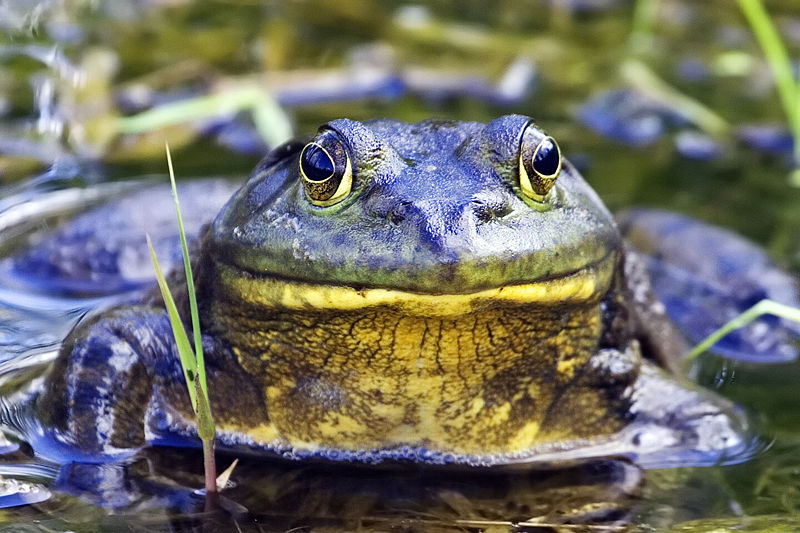
Time For Bullfrogs To Hibernate

As temperatures begin to cool, that big ol’ bullfrog (Rana catesbeiana) in your neighborhood pond is thinking about retreating to the bottom of the pond to spend the winter. Bullfrogs in our area will disappear from the edges of ponds and lakes around mid-October, burrowing under the mud at the pond bottom, or under leaf litter.
The bullfrog is a common species and was originally found only in the central and eastern United States and up into Nova Scotia. Unfortunately, efforts to commercially harvest frogs’ legs from bullfrogs has led to the introduction of the species to many western states, as well as Mexico and Cuba. There is concern that introduced bullfrogs compete with and displace native frog species in these areas. And they’ll eat almost anything that happens their way: worms, large insects like dragonflies, other frogs, and even unsuspecting hummingbirds.


Not sure that what you’re seeing is a bullfrog? Bullfrogs prefer the water’s edge along a vegetated bank. When alarmed they may jump into the water or hide among the dense vegetation. Like green frogs, they are varying shades of green and brown and yellow, but green frogs have a pair of ridges that run down the back. The bullfrog does not have these ridges, though it does have a ridge of skin that runs from just behind the eye and wraps around the eardrum. Adult bullfrogs are large, with body lengths ranging from three inches to a whopping eight inches. The distinctive ‘jug-o-rum’ call of the male is quite different from the banjo-twang call given by the green frog.
Bullfrogs spend their lives around water. Unlike terrestrial wood frogs that have a frenzied breeding season in early spring in temporary water bodies, the bullfrog breeding season doesn’t need to be completed in a two to three week span. Instead, bullfrogs breed anywhere from May to July in our area and from February to October in the south. And since eggs are laid in permanent bodies of water, the tadpoles don’t need to race against the clock to develop into frogs before their pond dries up. In fact, bullfrog tadpoles can take up to two years to transform into frogs, with some spending a winter or two in the tadpole stage. Look for these huge five-inch long tadpoles along the silty bottom of their aquatic home.

Submitted by Cindi Kobak

Image: Wikipedia

The Atlantic Flyway

As birds continue their migration along the Atlantic Flyway from their northern breeding grounds to their wintering areas in the Caribbean, and Central and South America, Audubon Connecticut’s Director of Bird Conservation Patrick Comins reminds us about the value documenting where shorebirds gather to feed and rest.
It would be helpful to document migrant shorebird usage in the state. Many of our shorebirds continue to decline at disturbing levels and the better we understand stopover foraging areas, high tide roosts, and other habitats that may be essential for them in migration, the better we can protect the places that are important to them. There is a easy way you can help, simply eBird your sightings and share them with ctwaterbirds@gmail.com.
It is important to track big concentrations areas for any migrants, but of particular concern are Lesser Yellowlegs, Semipalmated Sandpiper, Buff-breasted Sandpiper, and of course the few Red Knots that find themselves on the habitat limited coast of Connecticut and any concentrations of migrant Piping Plovers.

Dunlin - Terry Shaw
This only covers the globally threatened and candidate species, but American Oystercatcher, Solitary Sandpiper, Upland Sandpiper, Whimbrel, both godwits, Purple Sandpiper, Dunlin and Short-billed Dowitcher are all considered “Birds of Conservation Concern” by the US Fish and Wildlife Service.

Please keep in mind that these birds are on a tight energy budget and are of serious conservation concern, so please take care to avoid flushing them in the course of counts, and thank you for your help!

(From the September 2013 newsletter)

Citizen Science: MonitorChange

On the ground impacts of Global Climate change, sea level rise, changes to our forests and landscapes, development, all can be measured with precise scientific instruments. But the money and time to do so is often just not there and thus major changes around us are happening but remain undocumented. However, a partial solution is at hand by simply taking pictures over time from the same location. Combine those pictures into a sequence and you directly and permanently document and demonstrate change,and these changes can then be quantified.
MonitorChange (monitorchange.org) a concept to crowdsource changes in the environments where we live, work, play, or care about, be they parks, our backyards, our rivers, or our city scape, using nothing more than camera phones. The new thing here is that multiple people with multiple cameras can take pictures which are then processed using existing software so that no matter what camera type or format the pictures were originally taken with they are transformed into uniform snapshots of the same scene with the same dimensions with all the objects in the pictures the same size and shape. This allows all the different pictures to be put into time lapse sequences that can be made into a video, a slide show, or used to measure change direct over days, years, or decades.

The concept uses little more than a camera phone and a stout piece of bent steel to start.
A piece of angled steel is firmly mounted to provide a consistent height, angle and direction from which to shoot images using nearly any camera. When collected together, photo-stitching software aligns and pieces together images to show changes over time.


This concept has lots of applications to the type of work that ecologists, foresters, land managers, and environmental citizen groups do and provides an easy (and actually information dense) way of tracking long-term changes using volunteers using the smart phone that many carry in their pocket.
People can do this right now using existing materials at single sites or they can organize networks of camera stations at scales of parks, cities, watersheds, counties, states, countries, or the world.
Right now, MonitorChange is a presentation of an idea. Anyone can modify this in any way they like and implement it at any scale. No copyrights. No permissions needed. 
A short video explaining the MonitorChange can be found at http://youtube/A1ULAsEQAWs.
For more technical details on doing the picture rectification see the video at http://www.youtube.com/watch?v=w2pEKjw3Idk
Possible places/groups to implement are watershed societies, riverkeepers, stream crossings, trail clubs, stream monitoring groups; coastal beaches, dunes, marshes; lichen plots, restorations sites, forestry sites, parks, refuges, new developments, your backyard, construction of a building, the green-up in spring and the leaf drop in the fall of forests and so forth
For more information and to sign up go to monitorchange.org.
MonitorChange was developed by Sam Droege, a biologist at the USGS Patuxent Wildlife Research Center in Maryland.

Friday, August 9, 2013

Project Limulus 2013 Season

2013 was Menunkatuck Audubon's fifth year of volunteering for Sacred Heart University's Project Limulus.  It was another disappointing season for finding horseshoe crabs in Guilford.  There seemed to be even less on our beaches than last year.  The number of crabs counted during the surveys had been fairly consistent over the past 3 years but this year that number dropped by more than half.  According to the DEEP, the horseshoe crab population in Long Island Sound is stable, but we saw a significant change on the 2 beaches we survey in Guilford.


The 2013 survey period began on May 8th.and ended on June 25th.  Our Project Limulus team surveyed the 2 beaches at Indian Cove a total of 16 times and counted a total of 49 crabs.  We had to cancel more surveys than usual this year due to inclement weather and holidays.


150 crabs were tagged at the following Guilford beaches:  Indian Cove Public Beach, Indian Cove Private Beach, Shell Beach,Joshua Cove, Chaffinch Island, and Grass Island.

We found 34 recaptures.  Recaptures are crabs which have been previously tagged.

I would like to thank the volunteers who helped with the project at all hours of the day and night, in all kinds of weather.  This study could not be done without you.


                                             2010                     2011                  2012                   2013            

Total crabs tagged-            370                       975                     240                     150
Total recaptures-                  26                        262                       61                       34


                                             2010                    2011                   2012                   2013

Total crabs counted 
during surveys -                   151                      171                     165                       49


Total number of 
surveys conducted           2010                   2011                   2012                   2013

                                                  23                       24                        21                       16


Average number               2010                   2011                   2012                   2013 
of crabs per 
survey                                     6.5                       7.1                      7.8                       3.0