Monday, June 20, 2011

Japanese Barberry and Lyme Disease

An article in the New London Day describes a link between the invasive Japanese barberry and Lyme disease.

Jeffrey Ward, chief scientist at the Connecticut Agricultural Experiment Station's Department of Forestry and Agriculture, and experiment station scientist Scott Williams have been doing research on the relationship between Japanese barberry, ticks that carry Lyme disease and deer overpopulation.

A highly invasive plant that forms dense canopies in forests - particularly those with high deer populations that eat most every other plant - Japanese barberry also creates moist, cool shelters that harbor ticks that carry the Lyme disease bacteria, Ward's and Williams' research has shown. Hot, dry conditions suppress tick populations.

At 28 study areas, including a parcel along Lord's Cove in Old Lyme, the two have been studying various aspects of the triangular relationship between ticks, deer and barberry, and spreading their message to land conservation organizations about the best methods for ridding forests of barberry. Deer serve as hosts for adult ticks, while the barberry functions as a nursery for ticks in their juvenile stages.

Williams said tick abundance in barberry-infested areas is 67 percent higher than those where native plants are predominant. Also, the percentage of ticks that carry the Lyme bacteria is higher - 126 infected ticks per acre versus 10 per acre in barberry-free areas, Williams said, though the reason for that is as yet unclear. After barberry removal, Ward said, tick populations drop as much as 80 percent.

Go here for the full story.


Monday, June 13, 2011

Judy Knowles Talks about Horseshoe Crabs on WPKN

Menunkatuck's Project Limulus coordinator Judy Knowles was interviewed about the horseshoe crab research study on WPKN this afternoon. The interview is archived at http://archives.wpkn.org/bookmarks/listen/20959 and begins at about 15 minutes.

Monday, June 6, 2011

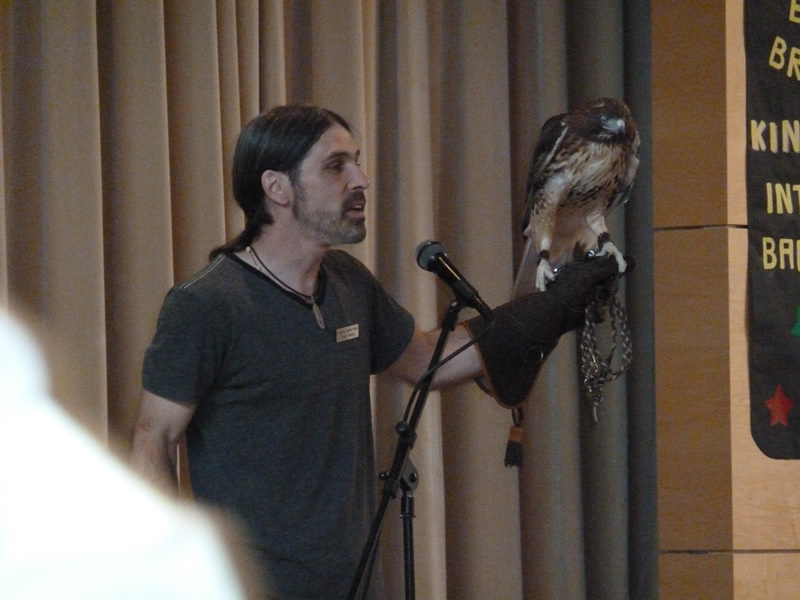
King/Robinson Students Experience Raptors from A Place Called Hope


The students at King/Robinson Magnet School in New Haven experienced live raptors from A Place Called Hope Raptor Rehabilitators today. In two programs, one for the Pre-K to Grade 4 students and the other for the Grade 5 to Grade 8 students, Christine Cummings and Todd Secki brought out five birds of prey.
An eastern screech owl and a great horned owl were the birds used to describe the unique features of owls. A red-tailed hawk and a broad-winged hawk showed the similarities and differences between the largest and one of the smallest hawks found in Connecticut.
The upper level students also got to see a barn owl in its second performance since coming to A Place Called Hope. The barn owl showed little of the shyness that Christine and Todd thought it might and gave the students a good show.


Monday, May 30, 2011

Menunkatuck Joins in Fishing Line Recycling Program


Menunkatuck has installed these cool fishing line recycling bins at several locations within our chapter area. Please deposit all fishing line you use (or find) into these bins to protect birds and other wildlife from entanglement. The bins will be emptied and the fishing line collected to be recycled by the following volunteers and town/state staff.
  • Guilford Town Marina - maintained by marina staff
  • Lake Quonnipaug boat launch, Guilford - maintained by Lorrie Shaw and Cindi Kobak
  • Hammonasset Beach State Park, Madison (5 locations within the park) - maintained by park staff
  • Madison/Guilford boat launch off Neck Road – maintained by Bob Kuchta
We plan to install several more recycling bins in the future at fishing sites in Branford and West Haven. If you know of an appropriate site and would like to volunteer to maintain a bin, please contact Cindi Kobak at program@menunkatuck.org.

Thursday, May 26, 2011

Menunkatuck Supports ‘Adopt a Book’ in Guilford

The Guilford Library recently put out the call seeking donations toward the purchase of new books for their children’s room. Menunkatuck Audubon answered that call to ‘Adopt a Book.’ Working with Suellen Heinrich at the library, we chose ten nature-related books to donate:


  • Backyard Birds – Peterson Field Guide
  • Birds of Prey – Peterson Field Guide
  • Bring On the Birds – Susan Stockdale
  • Can We Save the Tiger? – Martin Jenkins
  • Frog In a Bog – John Himmelman
  • Hatch – Roxie Munroe
  • Olivia’s Birds – Saving the Gulf – Olivia Bouler
  • Roscoe and the Pelican Rescue – Lynn Reed
  • Summer Birds: The Butterflies of Maria Merian – Margarita Engle
  • Thunder Birds – Nature’s Flying Predators – Jim Aronsky


Book plates will be placed in each of these books with the Menunkatuck Audubon Society named as donor. Share them with a favorite kid this summer when you visit the Guilford Library.


Thank you to our members, whose support made this donation possible.

Monday, May 23, 2011

New Birders’ Log Box at Hammonasset


Thanks to board member, John Picard, Menunkatuck has a beautiful new wooden box to store our Birders’ Log, newsletters, and our revised Birds of Hammonasset State Park Checklist. (Grateful thanks to Frank Gallo for working with us to revise the list, which now includes all 328 species of birds seen in the park.)

Publish Post

Please remember to record your bird sightings in the log after birding in the park. Birders can check the list to find what has been seen in the park recently, and to know where to look. The records are compiled at the end of the year and sent to Audubon CT and the CT Ornithological Association.

Happy birding.

Wednesday, May 18, 2011

Project Limulus Update: They're back!


A group of 12 Project Limulus volunteers met at Indian Cove on Sunday night,May 15th., at 9:40 and the crabs were finally there. We counted 6 during the actual survey but we were able to tag a total of 17. Sixteen crabs were tagged at the public beach and 1 was tagged at the private beach.

We are doing the survey by simple count now rather than dividing the beach into quadrats as we did during the last 2 years. We just walk through the water along the length of the beach, from the water's edge to 3 meters out, and tally single males, single females, pairs, and females with 2 or more males. After completing the survey we tag, tag, tag! Mark Beekey and Jennifer Mattei ( Sacred Heart profs in charge of the study ) decided to change the protocol for beaches measuring under 150 meters. It is much quicker and doesn't require as many people. It felt great to be out there again, getting up close and personal with the horseshoe crabs! We are hoping to count and tag many more crabs over the next few weeks now that their spawning season is under way.